How to Implement Data Governance Across Your Organization

Imagine a company generating vast amounts of data every single day, from customer interactions and supply chain updates to financial transactions and market insights. Without clear ownership or consistency, this data often turns into a tangled mess. Teams struggle to trust reports, decision-makers act on conflicting numbers, and opportunities slip through the cracks. That is where data governance steps in.
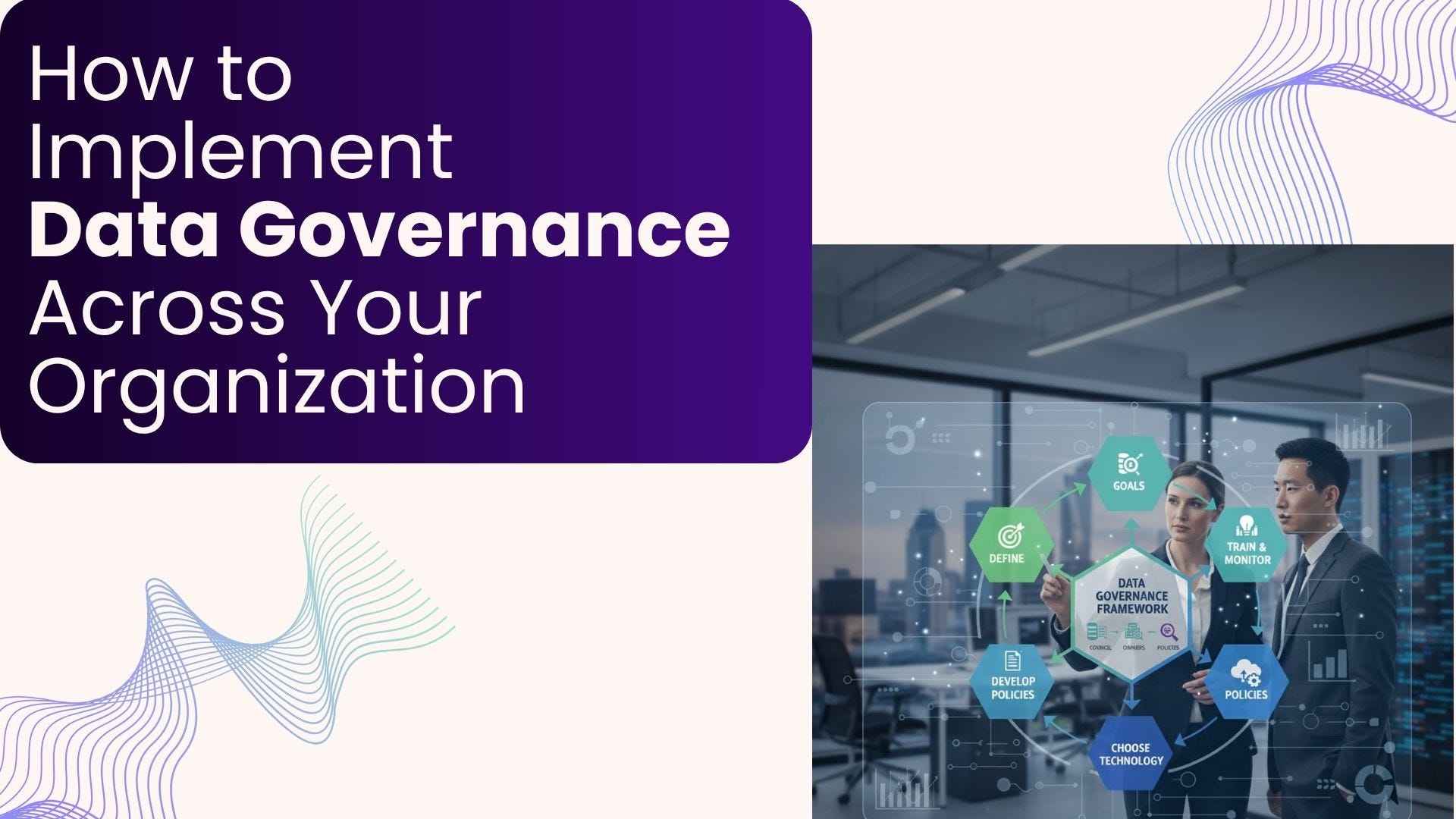
Understanding Data Governance and Why It Matters
Data governance is not merely about establishing guidelines for data management; it is fundamentally about creating an overall culture of accountability, accuracy, and trust that involves how data is collected, accessed, stored, shared, and used. Strong governance practices enable organizations to ensure that the data is reliable, consistent, and secure. This assurance of reliability allows organizations to underpin their decisions and build reliability in their compliance, decision-making, and operational excellence.
The governance function, when executed successfully, undergirds every data related initiative for the modern organization. Governance enables organizations to embrace data-driven transformation confidently and allows the organization to evade and reduce risks related to poor-quality data and unregulated data.
The Foundation: Data Engineering and Modernization
Building a strong data governance framework starts with a modern data infrastructure. Data Engineering & Modernization play a central role in setting up systems that support data consistency and accessibility across departments.
Legacy systems often store data in silos, making it difficult to enforce governance policies or maintain data integrity. Modernization helps organizations move to cloud-based platforms where data pipelines can be automated and standardized. Through structured data engineering practices, companies can define how data enters the system, how it is transformed, and how it should be accessed.
This foundation ensures that governance policies are not just written but embedded directly into the way data flows across the organization. It also helps reduce manual effort and the likelihood of human error.
Establishing Data Management and Governance Frameworks
After the infrastructure is complete, the next phase is developing the Data Management & Governance framework. This step consists of establishing ownership, roles, and policies for carrying out the data lifecycle process.
Start by identifying key data sources, including custodians, stewards, and business owners. Each group has a role in ensuring and maintaining quality and compliance. Next, identify the data standards to define how data is formatted, validated, and stored. Consistent definitions of data will eliminate ambiguity and maximize collaboration across your teams.
An appropriate governance framework should also establish regulatory compliance, access controls for systems with data, and data retention policies. A good governance framework manages these issues proactively to reduce the risk of expensive penalties and build confidence among your customers.
Using Data Analytics and Business Intelligence for Governance Insights
Governance is not just about control; it is also about enabling better insights. Data Analytics & Business Intelligence tools help organizations measure the effectiveness of their governance practices and make informed improvements.
Analytics dashboards can track data quality metrics, identify inconsistencies, and highlight usage trends. Business intelligence platforms can reveal how well teams are following governance standards and which areas need refinement.
With this visibility, companies can continuously enhance their data governance approach rather than treating it as a one-time project. Over time, this leads to smarter decisions, faster responses to market changes, and more aligned business strategies.
Enhancing Data Governance with AI and ML Solutions
Artificial intelligence and machine learning can take governance to a new level of efficiency. Sinki provides AI & ML Solutions that can automatically detect anomalies, classify data, and enforce rules across massive datasets. For instance, machine learning models can identify duplicate records or detect potential compliance risks in real time.
AI tools can also assist with metadata management by tagging and categorizing information automatically, reducing the burden on data teams. When paired with automation, these technologies make it easier to maintain data accuracy and streamline governance processes at scale.
In addition, predictive analytics powered by AI can help organizations anticipate governance issues before they occur, ensuring preventive action rather than reactive fixes.
Moving Toward a Data-Governed Culture
Implementing governance is not only a technical project but a cultural shift. Success depends on company-wide participation and awareness. Encourage teams to see data as a shared responsibility rather than a departmental asset. Training programs and internal communication can help reinforce the value of accuracy and transparency.
When leadership actively supports governance initiatives and employees understand the benefits, compliance becomes second nature. Over time, data-driven decision-making becomes faster, more reliable, and more aligned with business goals.
Conclusion,
Data governance is essential for organizations that want to turn data into a trusted business asset. It starts with solid Data Engineering & Modernization, strengthened by clear Data Management & Governance frameworks, supported by Data Analytics & Business Intelligence, and enhanced by AI & ML Solutions.
The most successful companies are those that treat governance not as a checklist but as an ongoing commitment to data quality and accountability. By investing in governance today, organizations set themselves up for smarter, safer, and more confident decisions tomorrow.